


Table of Content
The iterative process empowers your organization to learn and improve by embracing trial and error. It’s a flexible and efficient approach, allowing your company to respond to new information and market shifts promptly.
Large-scale projects often come with unexpected challenges, whether it’s surprising test results, client feedback, or shifts in the supply chain that can steer your project in a different direction overnight. The methodology you employ in project management determines how swiftly and effectively your team can adapt to such changes.
In a dynamic business landscape or a scenario with a short feedback loop, the iterative process proves beneficial. This adaptable method involves short, repeated cycles of previous iteration, culminating in a testable product or concept. These iterative cycles provide the flexibility to learn, adjust, manage risks, and make continuous progress toward your goal.
Iterative Process Definition
The iterative process involves the practical approach of building, refining, and enhancing a project, product, or initiative. Teams utilizing this development process go through cycles of creating, testing and revising until they achieve a satisfying end result. Imagine it as a trial-and-error method that guides your project toward its ultimate goal.
Iterative processes form a crucial component of lean methodologies and agile project management, but their applicability extends beyond agile teams to any group.
Throughout the iterative process, you continually enhance your design, product, or project until both you and your team are content with the final deliverable.

What Does Iterative Process Mean
The iterative process is a valuable technique for enhancing products, processes, initiatives, ideas, or designs. It begins with your team creating the initial version of the product, testing it, and pinpointing necessary adjustments. Subsequently, you go through the process again, incorporating the changes identified in the two previous iterations in each round. With each new iteration, the product becomes more refined, steadily approaching your desired outcome.
This method is a common practice across various industries, ranging from software development to graphic design. Scientists and research teams use iterations to fine-tune their experiments, while marketers rely on trial-and-error cycles for more targeted campaigns.
The iterative approach proves useful at the organizational level, allowing business leaders to implement gradual changes as they strive for more efficient and effective business strategies, processes, and procedures. As a team leader, the iterative process may serve as a fundamental component of your project management framework.
So What is a Non-iterative Process?
In a non-iterative process, you and your team collaborate to produce a final product without exploring new ideas along the way. Typically, non-iterative processes demand more time in the conceptualization and creation phase to ensure everything works as intended during testing.
The most common non-iterative process is the Waterfall model. In this iterative model, project phases are predefined before the project begins, and each phase commences only after the completion of the preceding one. Requirements and resources are typically fixed before the project starts, and the team aims to minimize changes to the project plan.
For instance, if you’re working with a design agency to create an ebook, you’d first provide all the copy, and then the design agency would create designs. Finally, your internal team would copyedit the designed ebook.
This exemplifies the waterfall model as each phase depends on the completion of the previous step (e.g., you can’t copyedit the designed ebook until it’s been designed).
Non-iterative processes, depending on the team and project type, can be challenging because they don’t incorporate time for iteration and continuous improvement. Engineering teams, facing numerous unknowns and surprises, often prefer iterative processes, but any team can benefit from incorporating iterative approaches.
The Iterative Process in Project Management
In project management, the iterative process simplifies initial planning, allowing you to commence the first cycle with concise goals and objectives.
These iterations, shorter than traditional development phases, offer ample opportunities to incorporate new insights and adjust strategies as the project unfolds. Learning through trial and error, your team can efficiently address significant risks early on, when they are easier and less costly to resolve.
The versatile nature of the iterative process allows for adaptation to different project scopes and team structures. Agile project management methodologies often leverage iterations to break down extensive projects into more manageable sections.
For instance, in the Scrum framework, these iterations are referred to as sprints, where each iteration cycle involves focused work on a project phase with specific goals. At the cycle’s end, progress is evaluated, and adjustments are made before moving on to the next sprint.
For projects with a clear and defined scope, such as developing software or creating a business logo, a streamlined iterative process yields swift results.
The feedback loop is rapid and efficient, facilitating immediate implementation of learned insights. Before deciding if an iterative approach suits your team, it’s beneficial to consider the potential benefits.
Benefits of Iterative Processes
- Reduced risk: Each iteration allows the team to identify and address small risks before they escalate into more significant issues.
- Easy adjustments: Iterations provide a moment to pause and reflect at the end of each cycle, allowing for the immediate incorporation of new information in the next iteration.
- Efficiency: The iterative process adapts easily to changes in the business, industry, and market, facilitating quick course corrections and enabling simultaneous work on different project components for faster progress.
- Sustainable innovation: The entire project cycle is traversed during each iteration, allowing teams to experiment with new ideas at minimal risk in terms of time and resources, fostering creativity and innovative solutions.
- Increased morale: Continuous improvement in the iterative process contributes to a sense of achievement and progress. With the project not relying solely on a single cycle, the environment remains low-stress and pressure-free.
- Better quality: Each iteration addresses small issues that might go unnoticed in longer product development cycles, resulting in a refined and high-quality final product.
- Lower cost: The iterative approach helps avoid expensive delays and bottlenecks common in more extended development cycles, proving to be cost-effective.
How to Implement the Iterative Process Model
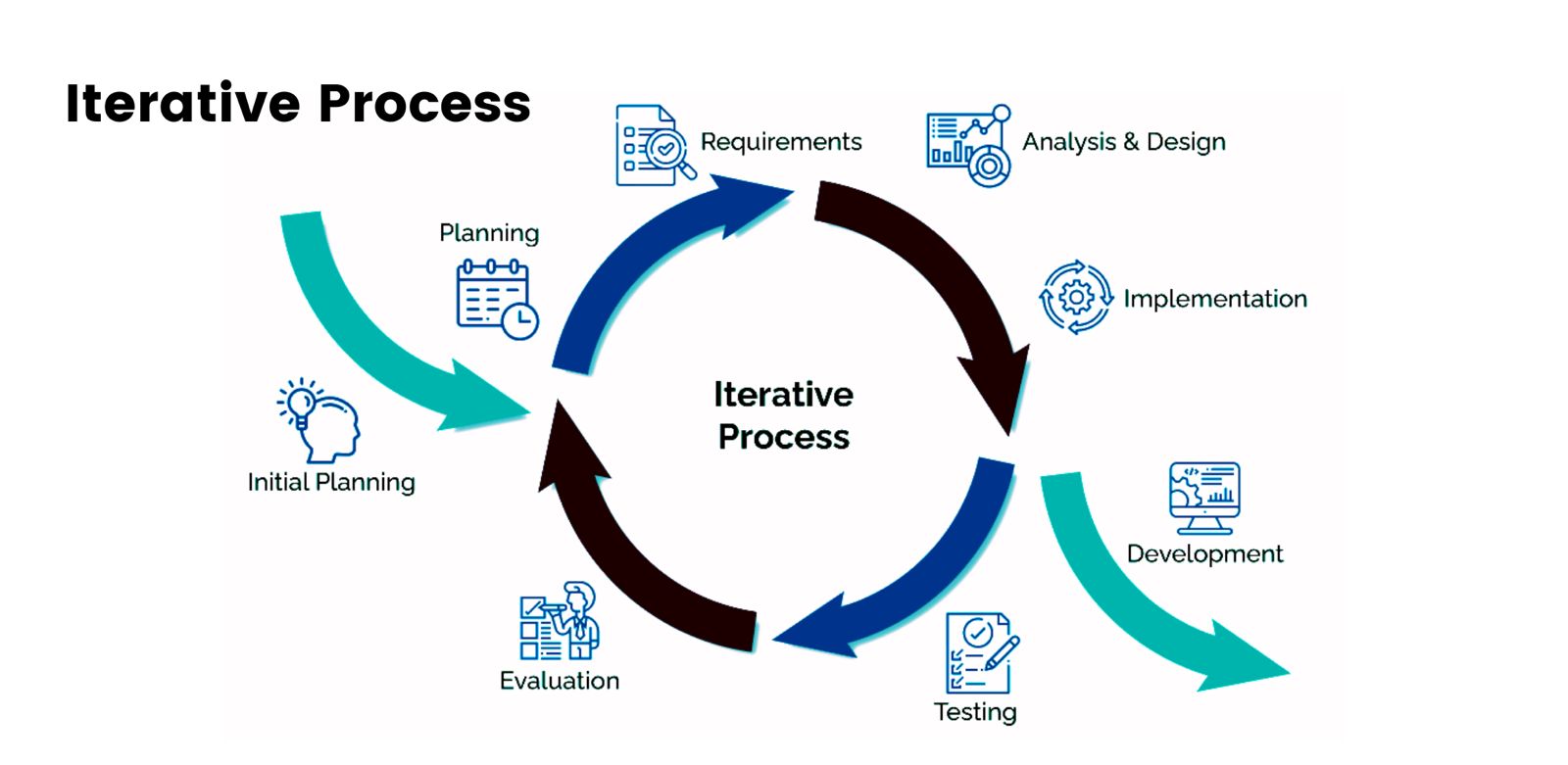
You need to take the following five key steps to implement the iterative process.
1.Plan
It all begins with a plan. You need a clear idea of what you want to achieve with your project. What are your goals, and what objectives are you aiming for? Additionally, think about the resources needed to complete the project, including technical requirements, time, money, and workforce.
Lastly, decide on the timeline for the project. How much time do you have to finish it, and what milestones do you need to reach? Having the right answers to these questions helps you understand the resources available at different stages of the project managers and the your project timeline.
2. Design
Once you’ve planned the project, the next step is to begin designing it. This is where you translate your ideas onto paper or into a digital format.
Consider the various components of the project and how they will integrate. This involves thinking about the user interface, the various database models, and the code.
Also, ponder on the different steps users will take when interacting with your project. What will they see, and what actions will they perform? This design phase is crucial for bringing your project to life in a way that makes sense and meets the needs of its users.
3. Implement
After completing the project’s design, it’s time to put it into action. This is where you start coding or building the project’s technical requirements.
You’ll be writing or building the code for the various components of the project. Additionally, during planning phase you’ll be assembling everything to ensure it functions seamlessly as a unified whole. This implementation phase is where your project takes shape and comes to life through the actual coding and construction process.
4. Test
Once the project is implemented, the next step is testing. This is where you thoroughly check the project to make sure it works as intended.
Testing involves checking each component of the project individually and also evaluating the project as a whole. It’s like putting your project through its paces to ensure it meets the expectations and functions seamlessly.
5. Evaluate and Review
Following the testing phase, it’s time to step back and evaluate the completed project. Take a moment to reflect on what worked well, what didn’t, and areas that could be improved.
Based on this evaluation, you can make a decision on whether to proceed with the project. If everything goes well, you can move on to the next iteration.
However, if there are areas that need improvement, you can make the necessary changes to enhance the project’s overall performance. This step ensures that the project evolves and aligns with your goals and expectations.
Examples of Successful Iterative Processes
Organizations, departments, and teams can all enjoy the advantages of the iterative process. Likely, certain parts of your business are already incorporating iterations organically. This approach fosters continuous improvement and adaptability, making it a valuable strategy for various aspects of your business operations.
Product Development
When companies are in the process of creating and updating products like appliances, smartwatches, or running shoes, they often undergo iterations in two key stages.
Initially, during the development phase, designers and engineers continuously create new versions of the prototype until the product aligns with the end consumer’s needs. The iterative development process doesn’t conclude once the first version of the product hits the market. If there is strong demand, it persists internally until version 2.0 makes its way to the shelves.
A notable example of an iterative process on a grand scale is the Apple iPhone. Each new model is a result of iterations that encompass customer feedback, new technologies, updated materials, and competitive analysis.
The outcome? A device featuring a higher-resolution camera, a larger screen, and improved waterproofing showcasing continuous refinement through incremental design iterations.
Software Development
Software engineers excel in the iterative process, consistently adjusting and refining code to address bugs, patch security holes, and enhance the user experience.
After completing the third phase of a cycle, developers release a new version. Consider the last time your phone or laptop received an update to the operating system—that’s the iterative process in action. This ongoing, incremental development and refinement ensures that software remains robust, secure, and aligned with evolving user needs.
Digital Marketing
Digital marketers leverage rapid-fire iterations to fine-tune and target their online campaigns. Utilizing data analytics tools like Google Analytics, they can monitor the real-time performance of ad campaigns, websites, or social media posts and make adjustments on the fly.
If an ad fails to resonate with the target audience, a marketer can tweak the copy in seconds and deploy the updated version. Through A/B testing, they can experiment with multiple blog titles and swiftly determine which one garners more clicks.
This agile approach in digital marketing allows for immediate responsiveness and optimization based on data-driven insights.
Graphic Design
The graphic design workflow typically revolves around iterations. The designer initiates the process by creating an initial concept or set of concepts aligned with the client’s needs and submits it for review. Subsequently, they refine the design based on the feedback received.
This iterative cycle continues until both the designer and the client reach a satisfying outcome. To manage scope creep and control costs, designers often define the number of iterations included in the contract, ensuring a structured and efficient iterative design process.
Using a project time tracking tool, such as TimeTrack, proves invaluable for optimizing iterative processes within your team or organization. TimeTrack offers a user-friendly platform designed to enhance project management efficiency through detailed time monitoring and analysis.
Try, Trial, and Try Again
In the end, every team can glean valuable insights from the iterative process. Embrace a trial-and-error mentality whenever possible, fostering an environment of flexibility and collaboration.
Regardless of whether you adopt the iterative method, always strive for continuous improvement in your work. This commitment to ongoing enhancement ensures that your team remains adaptable, innovative, and primed for success.

Zeitmanagement fesselt mich, denn gut genutzte Zeit und Qualität stehen für mich an erster Stelle. Als ehemalige Studentin in Publizistik und Kommunikationswissenschaft habe ich nicht nur das Schreiben, sondern auch die Kunst der gründlichen Recherche beheerscht. Ich möchte Ihnen dabei helfen, Sie durch effektives Zeitmanagement Raum für strategische Prioritäten schaffen zu können.

