


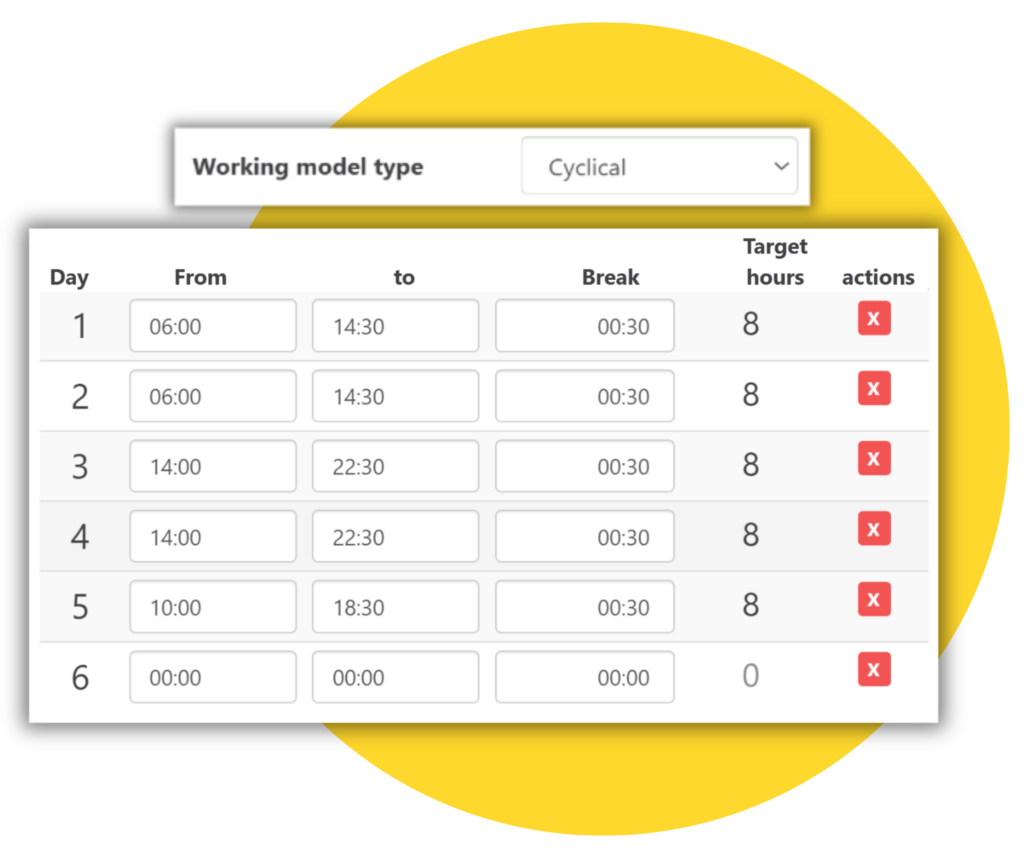
A rolling shift schedule can be created in TimeTrack, where employees’ shifts alternate in a set, cyclical pattern. In this work schedule model, your employees rotate regularly between different shifts, such as morning, afternoon, and night shifts. The plan repeats after a specific period, ensuring employees go through all shifts.
Forward-rolling and backward-rolling shift schedules are two different models for organizing shifts in a rotating schedule. The main difference lies in the order of shifts in which employees rotate.
Forward-Rolling Shift Schedule:
- In this model, shifts change in a forward-moving sequence, for example, from the morning shift to the afternoon shift and then to the night shift.
- The advantage of this model is that it tends to align better with the natural human biorhythm. As the working hours gradually shift later, the body has more time to adapt, which is less stressful for the sleep-wake cycle.
Example: A person works the morning shift (6:00–14:00) one day, the afternoon shift (14:00–22:00) the next day, and then the night shift (22:00–6:00).
A forward-rolling shift schedule can be acceptable if legal rest periods are maintained through additional rest days at the end of the cycle or if special agreements are in place to allow it.
Backward-Rolling Shift Schedule:
- In this model, shifts rotate in the opposite direction, from the night shift to the afternoon shift and then to the morning shift.
- This model is often considered more demanding because it disrupts the natural sleep rhythm more significantly. Employees must quickly switch from a late or night shift to an early shift, which makes adaptation more difficult.
Example: A person works the night shift (22:00–6:00) one day, the afternoon shift (14:00–22:00) the next day, and then the morning shift (6:00–14:00).


